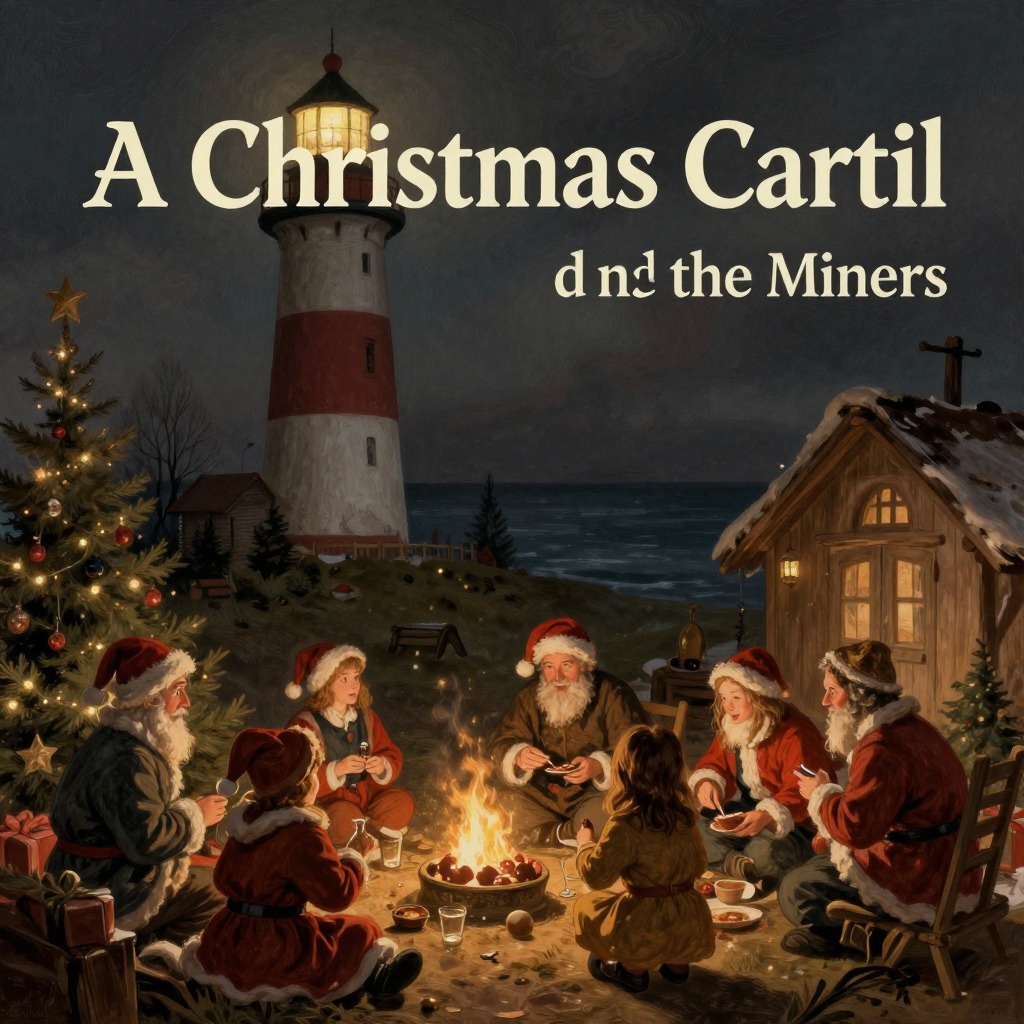
the lighthouse
The lighthouse appears in the journey of the Ghost of Christmas Present as a remote and desolate outpost, a place where the Christmas spirit reaches even the most isolated and dangerous corners of the world. Built upon a dismal reef of sunken rocks, some league or so from shore, on which the waters chafed and dashed the wild year through, it stands as a solitary beacon against the relentless sea. Great heaps of seaweed cling to its base, and storm-birds, born of the wind, rise and fall about it like the waves they skim. The lighthouse is a place of elemental exposure, where the natural world is at its most powerful and indifferent, yet it is precisely here that the Ghost of Christmas Present chooses to demonstrate the universality of his message.
The Lighthouse and Its Keepers
Inside the thick stone wall, two men who watch the light have made a fire that sheds a ray of brightness on the awful sea through a loophole. They are not named, but their actions speak of a shared humanity. Joining their horny hands over the rough table at which they sit, they wish each other a Merry Christmas in their can of grog. One of them, the elder, with a face all damaged and scarred by hard weather, like the figurehead of an old ship, strikes up a sturdy song that is like a gale in itself. The scene is one of stark simplicity: a fire, a drink, a handshake, and a song. The keepers' weathered hands and scarred faces testify to a life of hardship, yet they are not diminished by their circumstances. Their Christmas observance is a deliberate act of will and fellowship, a small but defiant assertion of warmth and community against the cold and the dark.
Narrative Significance
The lighthouse episode serves as a crucial expansion of the Ghost of Christmas Present's tour, moving from the domestic interiors of the Cratchits and the festive streets of London to the wild and inhospitable margins of the world. It follows a visit to a miners' hut on a bleak moor, where a family sings an old Christmas song, and precedes a journey to a ship at sea, where every man hums a Christmas tune. Together, these three locations—the moor, the lighthouse, and the ship—form a triptych of isolation, demonstrating that the Christmas spirit is not confined to comfortable homes or prosperous cities. The lighthouse, in particular, represents the furthest extreme of human solitude and danger, a place where the struggle for survival is constant. That the Ghost of Christmas Present chooses to visit such a place, and that the keepers respond with a simple, heartfelt celebration, underscores the story's central theme: that the spirit of Christmas can and should reach every human being, no matter how remote or perilous their station. The lighthouse is not a place of fear or despair, but of quiet, resilient joy.